
Articles
Unlocking the Power of Digital Twin Communication
Imagine a future where digital twins – digital replicas of real-world systems – not only monitor and optimise individual assets but also collaborate with one another to solve shared challenges. That’s the vision behind digital twin-to-digital twin (or “twin-to-twin”) communication.
For industries increasingly reliant on data-driven decision-making, this represents a significant opportunity. Think of smart cities, defence networks, or national infrastructure – domains where different systems must interact. Twin-to-twin communication could enable real-time coordination, improve forecasting, reduce duplication, and create efficiencies that benefit everyone involved.
Digital Catapult accelerates the practical application of deep tech, including the advancement of interoperable digital twin technologies. By enabling access to R&D capabilities and supporting early-stage deep tech businesses, we help bring transformative products and systems like these to market.
But there’s a challenge: digital twins are often built using different technologies, platforms, and data standards. Without a common way for them to “talk”, collaboration is limited or impossible. That’s where messaging protocols come in.
This article explores the case for a shared messaging schema – essentially a common set of rules or templates for how digital twins send and understand information – to support communication between digital twins, why it matters, and how Digital Catapult is exploring solutions at the UK Digital Twin Centre.
What is a digital twin?
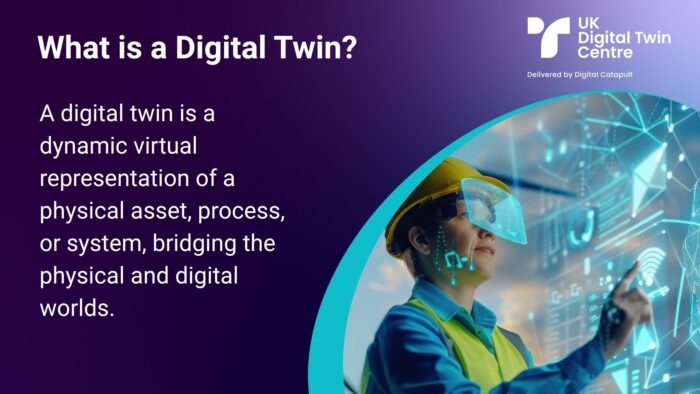
A digital twin is a dynamic virtual representation of a physical asset, process, or system, bridging the physical and digital worlds. The digital twin operates through a fully connected data flow between the physical asset and its virtual counterpart.
Real-time data from the physical asset – collected via sensors, IoT devices, or manual inputs – is continuously sent to the digital twin, allowing it to accurately reflect the asset’s current state, behaviour, and environment.
This enables businesses and organisations to simulate, predict, and optimise operations in real time. From individual machines and vehicles to entire buildings or supply chains, digital twins give decision-makers a clearer picture and the ability to act faster.
But when these twins exist only in isolation, their usefulness is limited. Without a way for systems to communicate clearly and reliably, critical opportunities are lost. This is why interoperability – enabling different digital twins to exchange information and work together, even if they are built by different organisations or exist in different domains – is essential.
The problem: communication without a common language
As digital twins become more powerful, the need for collaboration grows. Today, most digital twins use bespoke, closed messaging systems. These work well in isolation but create major barriers when connecting different systems, particularly those built by different vendors.
This is why the time is now to explore a standard messaging schema designed specifically for digital twins. It’s like agreeing on a shared protocol so twins can collaborate without translation errors or compatibility issues.
Where messaging matters
When designing communication systems for digital twins, there are three key interaction types to consider:
- Intra-twin: Communication within a single digital twin, between internal components such as sensors, AI models, and user interfaces.
- Exo-twin: External data inputs that inform the twin, such as weather forecasts, satellite data, or cybersecurity alerts.
- Inter-twin: Communication between separate digital twins, such as a ship’s propulsion twin sharing performance data with a fleet-wide fuel efficiency twin.
It is this third category – inter-twin communication – that holds the most transformative potential. But it is also the most complex, requiring a shared foundation for interoperability.
What a digital twin messaging schema needs to do

A shared messaging schema must go beyond basic data transfer. It needs to support:
- Real-time data exchange (such as telemetry and sensor data)
- Control commands and task coordination
- Trust and security between systems
- Twin discovery and self-description
- Collaborative planning and decision-making
In short, this is not just about sending messages – it’s about enabling intelligent systems to reason, plan, and act together.
Why existing messaging protocols fall short
There are already well-established communication protocols in other domains, including gRPC, MQTT, and AMQP. These do an excellent job of transporting data reliably and ensuring messages are sent and received.
However, in digital twin communication, it’s not just about moving data – it’s about understanding what the data means. Without agreed-upon semantics, different twins cannot interpret each other’s messages.
Learning from healthcare: a better way to communicate
An instructive example comes from healthcare. In 2011, Graham Grieve proposed FHIR (Fast Healthcare Interoperability Resources) to unify fragmented health IT systems. FHIR treats data as structured resources – such as patients, diagnoses, or appointments – with defined attributes and relationships.
For digital twins, a similar approach is needed: a shared schema that captures structure, meaning, and context in every message, and that can support multiple industries and use cases.
Enter ontologies and DTDL
To build such a schema, the “things” a digital twin knows about – its properties, behaviour, and relationships – need to be defined. This is where ontologies come in.
An ontology is a formal description of a domain that can be shared, reused, and versioned. Microsoft’s Digital Twin Definition Language (DTDL), released in 2018, is a widely used open standard that allows engineers to model physical systems in a way machines can interpret consistently.
UK Digital Twin Centre: building the tools
To support twin-to-twin communication and interoperability, the UK Digital Twin Centre is developing three key capabilities:
- Integration through messaging middleware: The DTaaS Workbench (Digital Twin as a Service) leverages established middleware technologies to enable scalable, reliable communication between components and systems.
- Collaborative domain modelling: Low-code tools are being developed to help experts define ontologies without needing to write code.
- A standardised messaging schema: The DTIR project provides a shared language for digital twins to communicate across vendors, platforms, and sectors.
Why this matters for you
For business leaders, policymakers, and technologists exploring the role of digital twins, interoperability should be high on the agenda. Without a shared communication framework, digital twins risk becoming siloed, duplicative, and limited in value.
This is not just about making systems smarter in isolation – it’s about connecting ecosystems, sharing intelligence, and solving problems collaboratively.
What’s next?
If your organisation is exploring digital twin interoperability or wants to understand how digital twins can integrate into your operations, we’d love to talk.
At the UK Digital Twin Centre, we are developing practical tools and open standards to help businesses adopt scalable, collaborative digital twin solutions. Whether you are starting your digital twin journey or ready to scale, now is the time to consider how your digital twins will communicate, collaborate, and evolve.
Get in touch with the UK Digital Twin Centre team to explore integration opportunities, pilot the DTaaS Workbench, or contribute to the development of Digital Twin Interoperability Resources.


.png)


